Industrial energy systems design · EcoXpert Power Management · Operating base: Monterrey Metropolitan Area

Your plant may be operating with electrical conditions not yet identified.

We integrate assessment, architecture, implementation decisions and follow-up for industrial power-management projects.

View System Architecture
EcoXpert EcoXpert Power Management
1 business day Personal response
EcoXpert Power Management — Certified by Schneider Electric
EcoXpert Power Management · Schneider Electric
PME EcoStruxure Power Monitoring Expert — operational energy monitoring according to project scope
Decision data Technical-financial evaluation based on project information, when applicable
5 stages Auditable framework: Assessment · Architecture · Orchestration · Execution · Continuity

EcoXpert Power Management.
Schneider Electric.

EcoXpert Power Management — Certified by Schneider Electric
EcoXpert Power Management · Schneider Electric.
The official badge identifies ROBGAM within the EcoXpert Power Management program. It does not replace the technical definition of each project.
Scope, deliverables and responsibilities are agreed before work begins.
01
System architecture before equipment specification
An installer executes what they are told. ROBGAM Energy defines what should exist, how it should be configured, and what technical margin the system requires under the agreed criteria — before a single piece of equipment is purchased.
02
Public identification through the official badge
EcoXpert Power Management · Schneider Electric.
03
Documented technical and financial decision criteria
Each project scope documents the technical basis, decision criteria and residual risk. Financial indicators are defined only when the baseline and scope allow it.

Conditions worth assessing
before a decision is made.

Each scenario must be assessed with plant data to determine its technical and economic relevance.

Power Quality
Possible CFE penalties that require assessment
Low power factor does not appear as a line item in the P&L — it appears as "high electrical tariff". Most plant directors assume the electrical cost is fixed. It is not. A structured technical assessment can determine in days whether your operation is absorbing avoidable losses — and quantify any relevant economic condition case by case.
Possible economic condition Condition to be confirmed through assessment — not assumed in advance
Operational Continuity
Electrical infrastructure that will not support the next expansion
When a plant plans capacity expansion, the energy system should be reviewed before investment and deadlines are committed. If installed capacity cannot support the new load, corrective redesign may create avoidable additional cost.
Corrective redesign cost Corrective-redesign cost, quantified through assessment
Operational Risk
Unplanned downtime from electrical failure without system assessment
A load and condition assessment can identify equipment operating outside the margins agreed for the project. Potential impact includes production downtime and effects on connected equipment.
Cost per hour of downtime Downtime cost according to industry and assessment
Financial Management
Energy investment decisions without verifiable financial justification
An investment decision must relate technical scope, cost and the risk of not acting. ROBGAM structures that evaluation with the data available for each project.
Over-sizing risk Risk of oversizing the invested budget

Operational control over your plant's
energy system.
Not over isolated equipment.

When the operational electrical network functions as an integrated system, the plant has real control over its consumption, its continuity and its investment decisions. ROBGAM Energy designs that integration — five capabilities that reinforce each other and reduce operational uncertainty in the electrical network.

Energy Visibility
Condition it addresses Operations that do not know how much they consume, where, when or why. Without measurement there is no management — electrical consumption becomes an opaque cost that nobody can intervene.
Capability it enables Continuous measurement per area, line and shift. Real-time monitoring with deviation alerts. Verifiable baseline for any efficiency initiative.
Operational Control
Condition it addresses Electrical infrastructure operated reactively — intervention happens when something fails, not when the system requires it. Without centralized control, every incident is a surprise.
Capability it enables Centralized operation of the electrical network. Real-time status supervision. Response capability before an abnormal condition becomes a failure.
Power Quality
Condition it addresses Harmonic distortions, voltage variations and low power factor that degrade equipment, generate penalties and reduce infrastructure lifespan without anyone identifying it as the root cause.
Capability it enables Stable electrical supply within design parameters. Assessment and correction of applicable penalty conditions. Protection of productive equipment against degraded supply conditions.
Electrical Protection
Condition it addresses Infrastructure without coordinated protection schemes. When a fault occurs, the disconnection is not selective — more goes down than should. The outage is bigger than the original problem.
Capability it enables Coordinated protection schemes that isolate the fault without affecting the entire process. Critical load continuity. Recovery criteria defined according to critical-load requirements.
Analytics & Decision
Condition it addresses Electrical data that does not yet translate into decisions. Infrastructure investments require a documented technical and financial basis.
Capability it enables Consumption and performance trend analysis. Predictive alerts based on historical deviations. Every investment decision backed by data from the operating system itself.
An energy system under control does not eliminate risk. It makes it predictable — and gives your operation back the capacity to decide how to respond.
The difference between an electrical installation and an energy system under control is that the system acts before the failure costs money, reports before the problem is visible and generates the data that justifies every investment decision. ROBGAM Energy designs that control capability — in the architecture, not in the equipment.

Industrial energy systems
designed to reduce operational uncertainty.

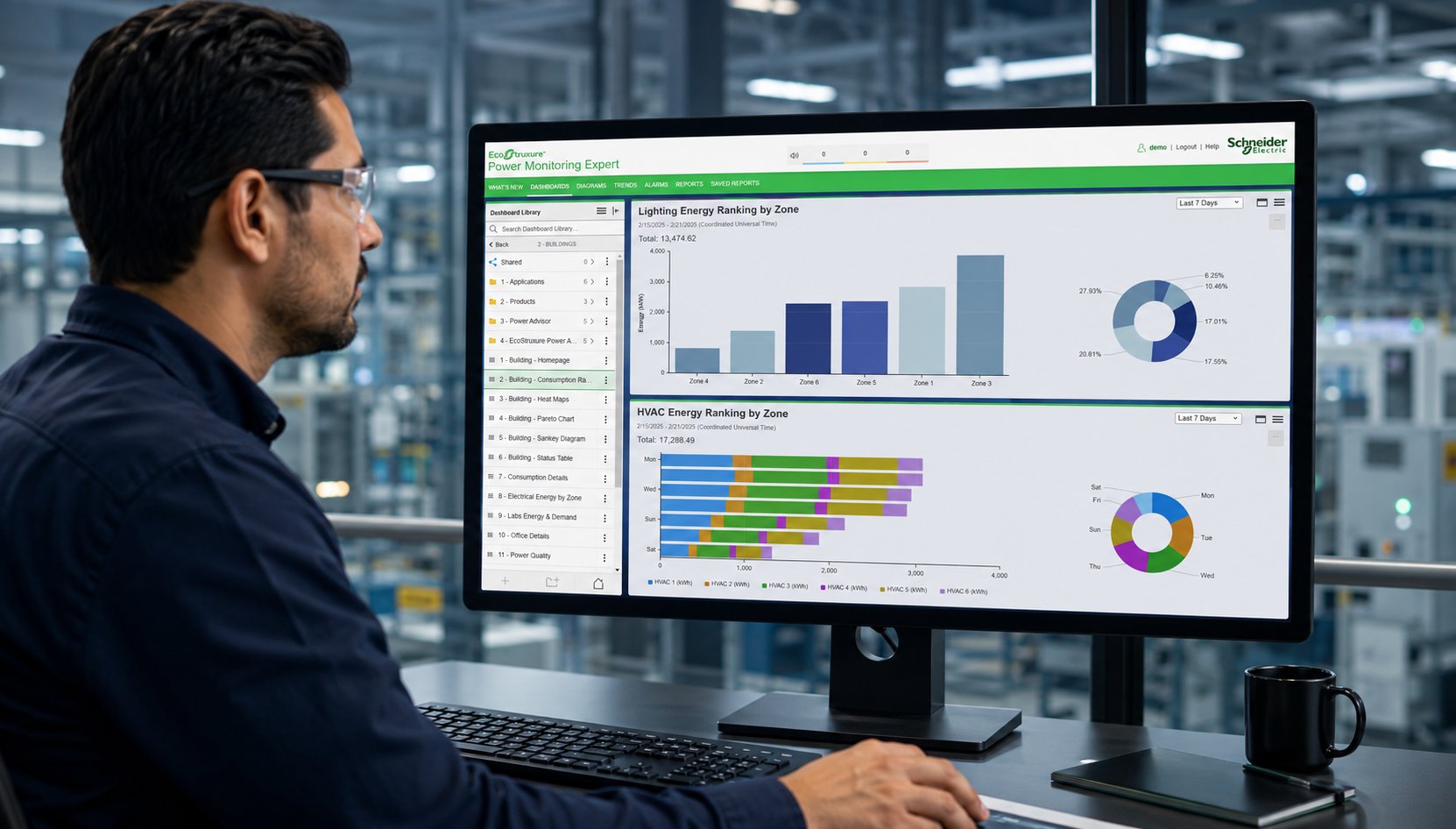
Technician reviewing a Power Monitoring Expert dashboard for industrial energy monitoring

EcoStruxure Power Monitoring Expert · Schneider Electric

Engineer operating a Schneider Electric MasterPact MTZ panel

MasterPact MTZ · Schneider Electric

01
Power Factor Assessment and Correction

Power-factor assessment and correction architecture defined from measured conditions and project requirements.

02
Energy Monitoring & Visibility

Implementation of PME (Power Monitoring Expert) with dashboards and monitoring functions defined by the project scope.

03
Power Quality & Harmonics Control

Diagnosis and correction of voltage drops, harmonics and transients that destroy equipment and trigger unplanned downtime.

04
Electrical Infrastructure Architecture

Design of substations, MV/LV switchgear, protection systems and automation that meet the actual operational and safety requirements of the facility.

05
EcoStruxure Integration

Deployment of EcoStruxure architecture for energy, power and process visibility according to scope — from field to cloud, with documented monitoring and applicable evidence.

5 stages.
Defined scope.
Documented criteria.

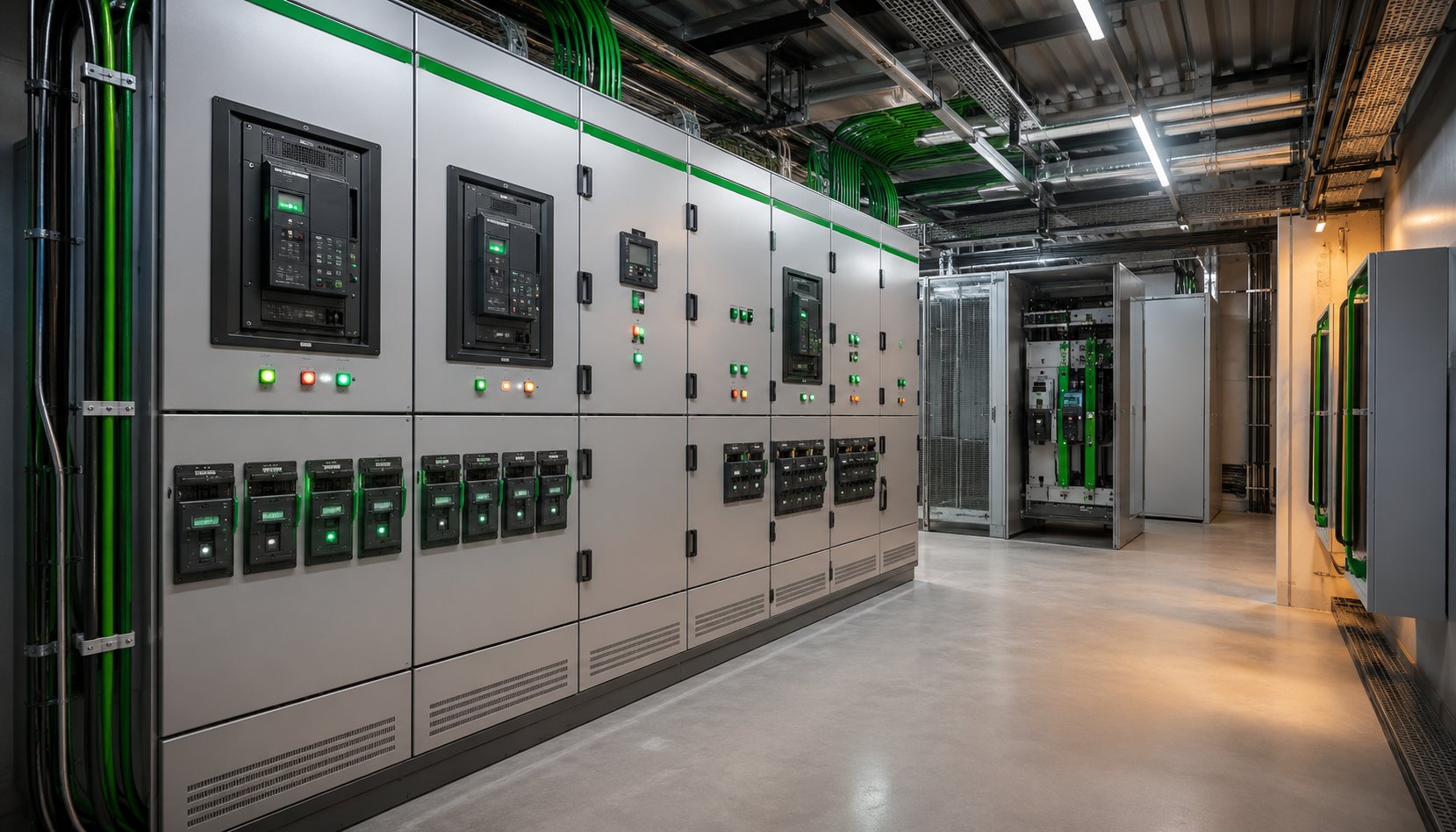
Industrial electrical control panel — Schneider Electric high-voltage infrastructure

Each project follows a structured process — not just a sequence of activities, but a method of technical risk control applied at each phase.

The client receives concrete deliverables at each stage, with acceptance criteria defined before starting.

01
Technical Assessment

Grid Code and power-quality studies are coordinated with a specialist partner when applicable. Scope, duration and deliverables are defined for each project.

02
Solution Architecture

Technical design with financial evaluation and risk analysis based on available project data.

03
Resource Orchestration

Coordination of specialists, providers, equipment and logistics with documented scope and responsibilities.

04
Controlled Execution

Coordination of implementation with project scope, responsibilities, deliverables and acceptance criteria documented.

05
Operational Continuity

Post-implementation follow-up according to the timing and indicators agreed for the project.

ROBGAM Energy does not compete with installers.
It operates where architecture,
risk and investment are defined.

The difference is not technical. It is who controls the decision about the energy system.

The difference lies in the layer where each actor operates. ROBGAM Energy defines the architecture — contractors execute it.

Vendor / Installer / Traditional EPC
✕
Quotes by component or by linear meter — not by business outcome
✕
Technical analysis is part of the sale — not an independent deliverable
✕
The financial decision is separated from the technical scope
✕
Incentive to maximize project scope to increase execution margin
✕
Manufacturer support depends on the applicable program and project scope
✕
Relationship ends at delivery — no post-implementation result validation
✕
Natural counterpart: procurement or maintenance management
ROBGAM Energy Solutions
✓
Structures projects with technical scope, financial evaluation and documented responsibilities
✓
Technical assessment is the first deliverable — independent of the investment decision
✓
The client approves with verifiable financial analysis before committing the budget
✓
No incentive to maximize scope — ROBGAM wins on correct architecture, not executed volume
✓
EcoXpert Power Management · Schneider Electric
✓
Post-implementation follow-up on the timeline defined for the project
✓
Natural counterpart: CFO, Operations Director, Plant Director

Energy investment does not fail
for lack of budget.
It fails for lack of structure to decide.

ROBGAM Energy structures the decision for two critical counterparts: the one who protects capital and the one who protects the operation.

What a CFO needs to see to approve

  • The current cost of not acting, quantified.
  • The financial risk of continuing to operate with the current electrical network.
  • The required CAPEX with technical and financial justification.
  • Applicable financial indicators and their assumptions.
  • The residual risk after the intervention.
  • The difference between investing today and paying more in correction later.

ROBGAM does not present a technical quote.
It presents a structured investment decision.

What an Operations Director needs to control

  • Which part of the system is currently out of parameter.
  • Which failure can halt production and under what condition.
  • What real capacity the electrical network has to grow.
  • Which risks can be reduced and which must be managed.
  • What response the system will have when a contingency occurs.
  • What operational visibility will exist after intervention.

ROBGAM does not install equipment to "improve" the plant.
It designs the system the operation can control.

The typical objections are not technical.
They are about decision.

"We don't have budget yet."
Then you need visibility on the cost of not acting. Without that, you are not saving — you are postponing a loss you have not quantified. The structured technical assessment gives you that number before committing a single peso.
"First we need quotes."
Quoting without defined architecture only compares prices of poorly framed scenarios. First define the correct system. Then compare execution. Without that order, the cheapest quote tends to be the most expensive.
"We can solve it with our current vendor."
Your vendor can execute. The question is whether they can also define, with technical independence, the architecture that best serves you — and not the one most convenient for them to sell.
"It doesn't seem urgent."
Most industrial energy problems do not present as emergencies. They accumulate as cost, degradation and lost capacity — until a failure forces an expensive, rushed decision.
When the decision is poorly structured, the project is born wrong.
When the architecture is well defined, execution stops being a gamble.

If your operational electrical network is not being controlled as a system, the risk is not occasional — it is cumulative.

The structured technical assessment defines the complete architecture of the energy system before committing budget. ROBGAM Energy delivers a technical analysis with quantified findings, risk map and intervention scenarios — the base on which your leadership can make decisions with real control over the system.

Go to contact form
The structured technical assessment includes:
Grid Code and power-quality studies coordinated with a specialist partner; duration and deliverables are defined by project
Analysis of available CFE history over the period defined for the project
Technical inventory of the operational electrical network — installed capacity vs. real demand
Identification and quantification of possible operational risks not previously documented
Structured technical report with quantified findings and intervention scenarios
Deliverable that defines the architecture — independent of any commercial proposal

Tell us about
your energy
system.

We review the request and respond personally by the next business day. Scope, duration and deliverables are then defined with project data.

What we assess

Installed electrical infrastructure, consumption profile, possible CFE penalties, energy visibility, critical-equipment condition and operational-risk exposure.

What we deliver

Technical architecture, risk analysis and technical-financial evaluation when the scope allows it.

Direct contact

energy@robgam.com.mx

Request Assessment
ROBGAM Energy Solutions · Personal response by the next business day

Privacy: ROBGAM Group Solutions, S.A.P.I. de C.V. will process the contact, business and technical information you submit to register, respond to and follow up on your request. It will not use it for unrelated advertising without any required consent. You may limit use or withdraw consent at contacto@robgam.com.mx. Read the full Privacy Notice.

REQUEST SENT. CHECK YOUR EMAIL TO CONFIRM REGISTRATION.

Registration is confirmed when you receive our email. If it does not arrive within 10 minutes, check spam or contact us by WhatsApp or email. We review each request and respond personally by the next business day.

WhatsApp